All real
living is
meeting
Martin Buber, philosopher of dialogue
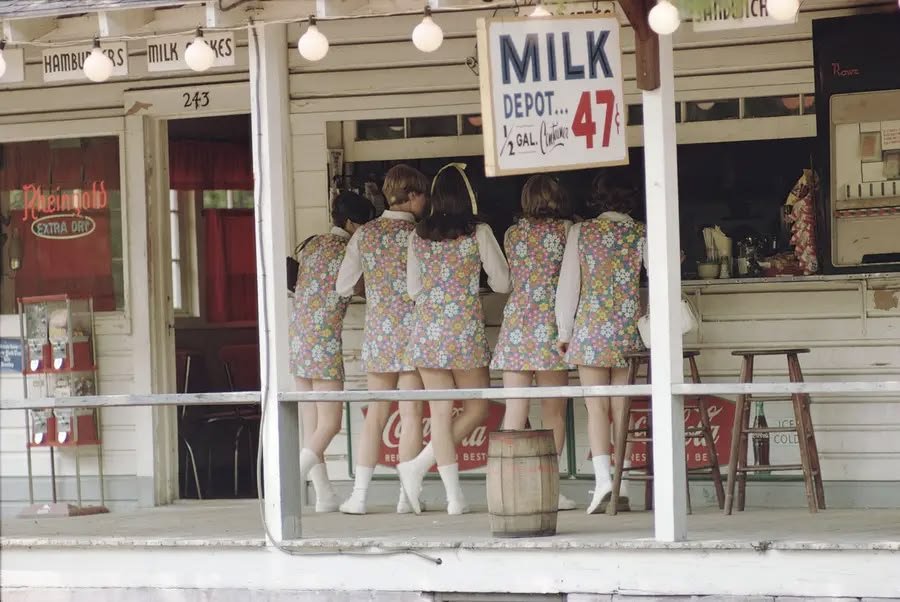
Soon everything a brand shows on a screen will be copied in minutes. It already is. The visuals, the words, the tone, the very description of who you are: a machine reproduces them faster than you can be distinguished by them.
One thing will not reduce to a file. A living place, and the people who come back to it. That cannot be built overnight.
This is the work of the bureau: to build that distinction, and to show it in your own figures.
WHY NOW
What grows dearer
As the digital loses its value, the real recovers it. What once set a brand apart now generates in minutes, and so distinguishes nothing; presence, the thing that asks for time and a body, becomes the scarce one.
The screen promised closeness and withheld it. Those who live most on it are twice as likely to be lonely. So people return to what cannot be scrolled past: a room, a meeting, the company of their own.
They will pay for it, and pay more, precisely because so little of it is left.
Brands feel the shift and move offline: pop-ups, flagships, events. Yet most of it stays an impression rather than an asset. A peak on opening night, traffic back to baseline within the month, and on the ledger a line of cost without a line of return. This is the line the bureau works on: between a place that was admired, and a place that pays its way.
WHAT WE OWN
What we answer for
The largest banks in the world commit hundreds of millions to physical places of belonging, and cannot show what those places returned in retention. Not because the effect is absent. Because no one has learned to measure it.
That measure is the work. The bureau does not deal in atmosphere; it deals in return: how often people come back, how few of them leave, what they are worth over time, how cheaply they bring others. The language a board already keeps a budget in.
The market knows how to make an impression. The bureau answers for what the impression leaves behind, and for whether it can be carried into the boardroom.
HOW IT WORKS
In its
proper order
Return cannot be built around a brand that has never read itself. So the work runs not as a list of services but as a ladder, in strict order.
Who the brand is
Its character, and the motive beneath it. This is the ground: the archetype decides what the space becomes, the tone the community speaks in, what takes root and what does not. The question is not whether it pleases, but whether it can be read. Everything after rests on that.
Where it lives
The space as that character made physical, and as a converter into return and spend, not as décor. Character leads the space, not taste; the space leads to a measure, not to a photograph. An environment is designed to change behaviour, not to be admired.
Who comes back
Community is the highest form of value, and becomes possible only once there is a who, a where and a how many. It is a position on a ladder of your own, one people do not leave. A competitor will reproduce the product and the price. The web of people who return, they will not.
THE ECONOMICS
A community is neither the charm of a place nor luck. It is a mechanism, and it is designed.
The format assembles not from the product but at the meeting of two things: what an audience chronically lacks, and what the brand has earned the right to gather around. People are held not by points or discounts for showing up; those crowd out the only reason to return, which is that here are one's own. They are held by roles, by rhythm, and by small groups where an absence is noticed.
There is a boundary to this, and keeping it is part of the work. A healthy community leaves a person freer to live beyond it; past that line begins what a brand would be ashamed to show a journalist. The bureau keeps that boundary deliberately, and that too is an asset.
How
return
is made
The product
is copied.
The price
is reproduced.
A web of belonging
is not.
PROOF
I once built a private community for the senior figures of an industry: not advertising, but dinners, introductions, relationships in place of campaigns. It lifted the line so far that the community stopped being a cost and became a line of revenue. We measured that effect and defended it to the leadership, or I would not raise it here.
The same mechanism holds at scale. At one of the largest technology companies in the world, members of its community spend markedly more and leave at a fraction of the rate of others; in its annual filing the company ties its low attrition directly to its customer programmes. The mechanism is one and the same: first people help one another, then they are given a voice, then standing, then they meet in person.
The product is copied. The price is reproduced. A web of belonging built over years is not.

Behind me lie more than fifteen brands and dozens of physical spaces, from closed clubs to conferences of five hundred. I have taken to market products the market did not yet understand, and answered for the commercial result rather than the handsome slide. One partner brand I carried from a share no one noticed to the lead of its category. Distinction is not a matter of taste. It is what shows, in the end, in the revenue.
ENGAGEMENT
The work begins not with a package but with a diagnosis.
The first step reads your situation: who your brand is, what the physics of your location allows, what your audience chronically lacks, which measure can honestly be moved here. The diagnosis shows whether an asset is there, and of what size. If it is not, the bureau will say so plainly.